admin admin

create a pic : Hydrogen storage in London: Routes to a greener energy future

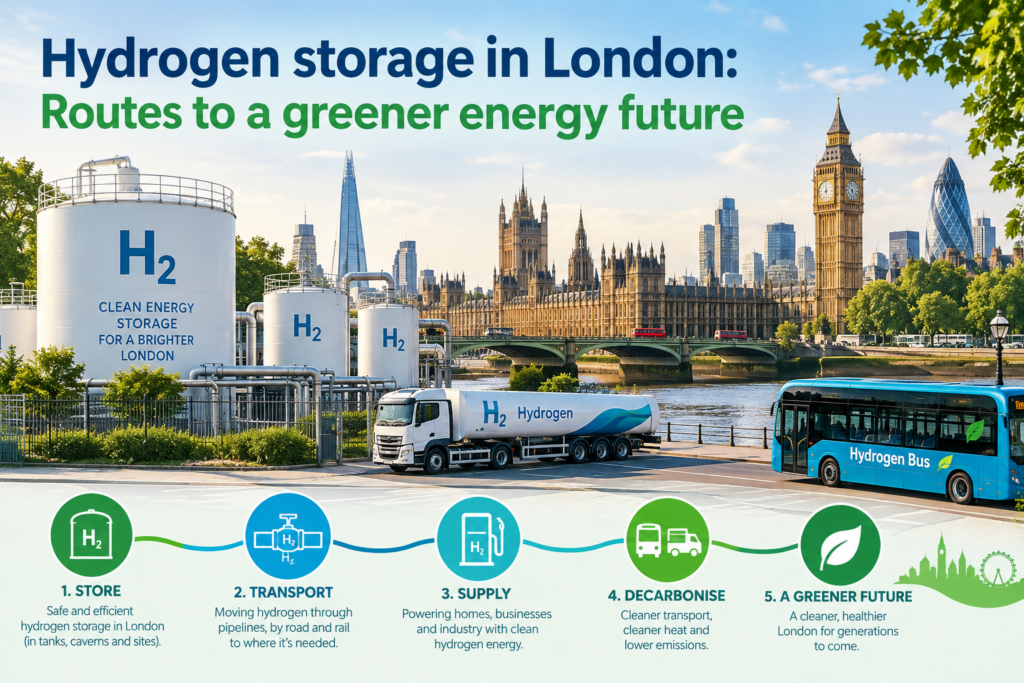
Hydrogen storage in London: Routes to a greener energy future

London is at the center of the UK’s move toward a cleaner, more resilient energy system. Hydrogen is emerging as a potential low-carbon energy carrier as transport networks, industries, public infrastructure, and companies work to reduce their carbon emissions. But the production of hydrogen is only half the battle. Storing it safely and efficiently is also a critical component of building a dependable hydrogen economy. The question of hydrogen storage in London is becoming ever more pertinent as the capital looks at ways it can support clean energy, industrial decarbonization, low-carbon transport, and energy security. Good storage solutions can help to balance changes in the amount of hydrogen that is available and the amount that is needed and can make sure that hydrogen is available when it is needed and where it is needed. Hydrogen projects can be complex, so if you are an organization considering a hydrogen project, working with experienced H2P Energy Consultants in London can provide helpful support in understanding technical, commercial, regulatory, and infrastructure requirements. London’s Energy Transition: The Importance of Hydrogen Storage Hydrogen can be produced using a range of technologies and has the potential to be used across sectors that are hard to decarbonize using direct electrification alone. The applications are heavy transport, industrial processes, energy storage, and some high-temperature applications. But it’s unlikely that hydrogen demand will be constant over a day or a year. Output can also be affected by the availability of electricity, renewable generation, or operating conditions. This requires efficient storage of hydrogen. Storage can assist: • Balance supply and demand of hydrogen • Enhance energy system flexibility • Provide backup power during outages • Support hydrogen’s industrial users • Refueling infrastructure enablement • Enhance asset utilization for hydrogen production * Support integration of renewable energy Developing an appropriate storage strategy can therefore be an important part of a wider Decarbonization Strategy in London for London-based organizations. Hydrogen Storage Technologies Demystified Hydrogen can be stored in many ways. The right technology is determined by factors such as capacity required, pressure, application, location, duration, safety requirements, and cost. Compressed Hydrogen Storage (CHS) Compressed gas storage is one of the more mature solutions for hydrogen applications. Hydrogen is compressed and stored in tanks or containers at high pressure. Such an approach is especially relevant for applications where relatively fast hydrogen dispensing is required, e.g., some transport applications. The main benefits include: • Proven technology • Simple to deploy • Rapid access to stored hydrogen • Suitable for small and medium-sized applications However, compression requires energy, and storage vessels must be built to appropriate engineering and safety standards. Liquid Hydrogen Storage Hydrogen can also be turned into a liquid by cooling it to very low temperatures. Liquid hydrogen is more energy dense in volume than compressed hydrogen and so may be attractive where there is a need to store or transport large quantities. Liquefaction, however, is energy-intensive and requires specialized cryogenic infrastructure. Thus, feasibility studies are necessary for large-scale projects before the choice of liquid hydrogen storage. Hydrogen Storage Underground Underground storage is another area of considerable focus for long-duration and potentially large-scale energy storage. Suitable salt caverns or other formations may be considered for potential geological storage, subject to geological, regulatory, engineering, and environmental considerations. Eventually, large-scale storage could also provide hydrogen networks with hydrogen when demand is low and take hydrogen away from the network when demand increases. Hydrogen storage and London’s decarbonization objectives Hydrogen storage cannot be viewed in isolation from the broader energy transition. A successful decarbonization strategy for London needs to consider interactions across different energy technologies. Electrification, energy efficiency, renewable power, hydrogen, energystorage,e and alternative fuels can all do different things. Hydrogen could be particularly useful for applications where direct electrification is technically difficult, expensive, or operationally unsuitable. Storage provides the flexibility that reinforces this proposition. For example, hydrogen can be stored when there is plenty of renewable electricity and used later. This provides a way to move the available energy through time. Businesses considering long-term carbon reduction programs should be looking at hydrogen storage, alongside electrification and other low-carbon technologies. H2P Energy Consultants London But hydrogen infrastructure planning is so much more than swapping in a storage tank or technology. Organizations need to balance demand forecasts, production options, transportation requirements, safety, regulatory, capital expenditure, operating costs, and future scalability. This is where H2P Energy Consultants in London can add value. Specialist energy consultants can help organizations assess the technical and commercial viability of hydrogen projects as part of their wider decarbonisation aims. A hydrogen consultancy project could involve: 1. Preliminary feasibility study – Determining the organization’s hydrogen needs & objectives. 2. Demand analysis—Estimates of current and future hydrogen use. 3. Technology assessment—Comparison of appropriate technologies for production and storage. 4. Infrastructure planning – Assessment of storage, distribution, compression, and connectivity needs. 5. Risk assessment—Identification of technical, operational, and safety considerations. 6. Economic modeling—Comparison of capital and operating costs. 7. Strategic planning—Connecting the project to long-term energy and carbon reduction aspirations. This systematic approach helps to reduce uncertainty and helps businesses to make informed investment decisions. Hydrogen Storage in Industry London and the wider UK industrial sector are under ever-growing pressure to cut emissions while remaining productive and competitive. Hydrogen could be a possible alternative energy source for selected industrial processes where conventional electrification is difficult. Storage also offers additional operational flexibility for industrial users. In a facility, hydrogen may be required at a fairly constant flow rate, but the hydrogen production or delivery may be intermittent. Storage can be a buffer between supply and demand. This will help companies to manage supply variations and improve the reliability of hydrogen-powered equipment. Hydrogen Storage & Transport Hydrogen storage can be important in another field: transportation. Hydrogen fuel-cell vehicles need reliable access to hydrogen refueling infrastructure. Refueling stations need to have enough storage capacity to deal with demand and to supply hydrogen at the right pressure levels. Heavy-duty vehicles, buses, specialist fleets and potentially other transport applications could

Hydrogen storage in London: Routes to a greener energy future Read More »
Hydrogen Storage

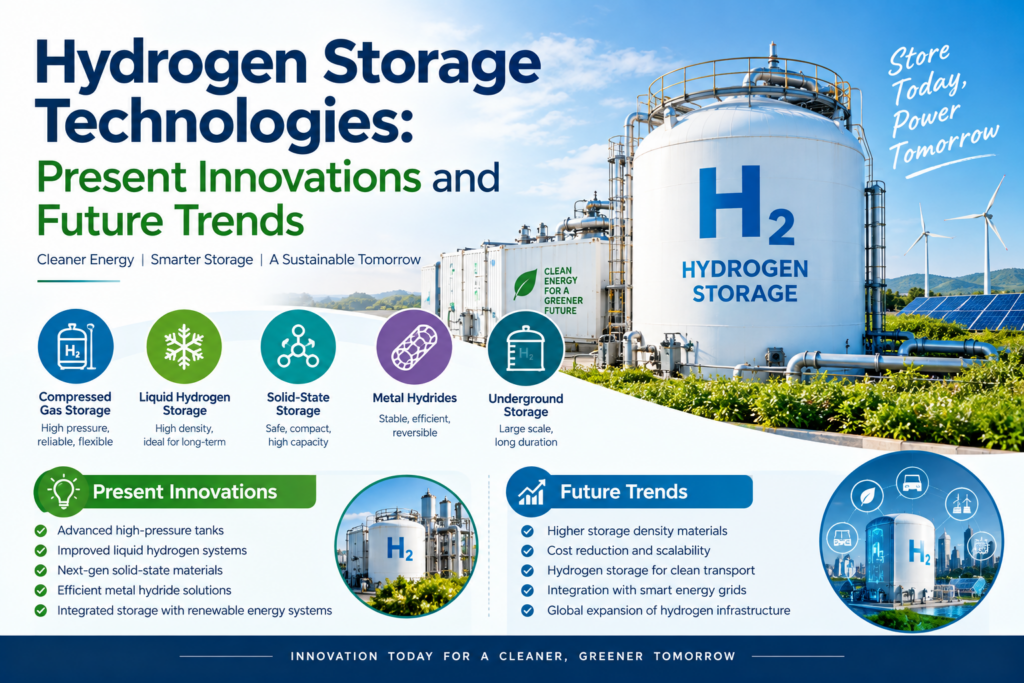
Hydrogen Storage Technologies: Present Innovations and Future Trends

In a world moving toward cleaner and more sustainable energy solutions, hydrogen is emerging as one of the most promising alternative solutions to fossil fuels. Despite rapid advances in hydrogen production, efficient storage is one of the most critical challenges to widespread use. Today’s hydrogen storage technologies are evolving to enable industry, transportation and large scale energy systems.Businesses in London looking for reliable Hydrogen Storage Facilities and Services are increasingly turning to sophisticated storage solutions that offer safety, efficiency and long-term sustainability. With technology continuing to improve, hydrogen storage is becoming more and more practical and affordable. The Importance of Hydrogen Storage Hydrogen is an energy carrier that can be produced from renewable sources and is a key element in the global transition to clean energy. However, the volumetric energy density of hydrogen at ambient conditions is very low compared to conventional fuels. This means that it has to be stored in a special way for transport and industrial use. Efficient storage of hydrogen enables:  • Lower carbon emissions• Better integration with renewable energy• Increased supply of fuel for transport• Improved industrial processes As the demand for hydrogen increases, it is necessary to develop advanced storage technologies. Technologies for Hydrogen Storage Today There are a number of storage methods in use today in a variety of industries, each one with its own benefits depending on the use. 1. Hydrogen Storage (Compressed) Compressed gas storage is the most common method in use today. Hydrogen is stored in high-pressure cylinders or tanks, usually at pressures between 350 and 700 bar. Benefits: • Infrastructure widely available• For refueling and transportation stations• Fast filling abilities Challenges:• High pressure requirements• Energy consumption in compression• Huge storage capacity This technology is still one of the preferred options for commercial hydrogen storage facilities. 2. Storage of Liquid Hydrogen Hydrogen can also be stored in liquid form, if cooled to around -253°C. Advantages: • Denser in energy • Applicable for mass transportation • Reduced storage volume However, because it must be kept at cryogenic temperatures with sophisticated insulation and constant energy input, it is more expensive than compressed storage. 3. Metal Hydride Storage Material Metal hydrides store hydrogen in special alloys and release the hydrogen when heated .Key benefits: • High level of safety• Lower pressure at operation• Storage space savingThis technology is particularly attractive for stationary energy storage and for some industrial applications. 4. Hydrogen storage in chemical form Hydrogen can be transported and stored more efficiently using chemical carriers, e.g. ammonia and liquid organic hydrogen carriers (LOHCs).Benefits include: • Transport is easier• Ability to store for long termResearchers continue to improve the conversion efficiency so that this method can compete in the commercial marketplace. 5. Hydrogen Storage Underground Seasonal hydrogen storage in large underground caverns, depleted gas reservoirs and salt formations are increasingly considered. Benefits include the following: • Enormous storage capacity• Reduced operating costs• Balancing of grid scale energy• Renewable Energy Integration SupportThis solution is expected to play a major role in future hydrogen economies. Recent progress in Hydrogen storage Technological innovation is improving hydrogen storage performance in many sectors.Advanced Composite Vessels Modern carbon-fiber composite tanks offer: • Strengthen• Weight reduction• Enhanced durability• Enhanced safetyThey are gaining popularity in hydrogen-powered cars and industrial transportation systems. Storage Based on Nanomaterials Scientists are developing nanomaterials capable of storing more hydrogen in a smaller volume. The most promising materials are:  • Carbon nanotubes• Graphene• Metal organic frameworks (MOFs) These technologies could lead to much greater storage efficiencies in the years ahead. Smart Storage Monitoring: Digital technologies now play a key role in managing hydrogen storage.Modern facilities use: • IOT sensors• AI-based monitoring• Leak detection in real time• Predictive maintenance.• Automated pressure controlSuch innovations improve operational efficiency and safety. Better Cryogenic Systems New insulation materials and cooling technologies are reducing the energy losses associated with liquid hydrogen storage, making cryogenic systems more commercially viable. Hydrogen Storage: What to ExpectThe hydrogen industry is expanding rapidly and a number of trends are expected to shape its future. Green Hydrogen Infrastructure Growth Governments and private sector companies continue to invest in green hydrogen production and storage infrastructure. Future facilities will probably include: • Integration of renewable energy• Smart energy management• Cut operational emissions Integrating Renewable Energy Hydrogen storage could be a way to compensate for the intermittent nature of renewable energy sources such as wind and solar. Surplus renewable electricity can be used to produce hydrogen via electrolysis, which can be stored for later use, thus increasing overall energy reliability. Transportation Applications Expansion Hydrogen-powered vehicles continue to gain momentum across the board: • Heavy trucks• Transportation (public)• Training• Transportation by sea• Aeroplane As more people adopt it, the demand for sophisticated hydrogen storage facilities increases. Final thoughts: Clean energy systems and the global transition to net-zero emissions are being enabled by the rapid development of hydrogen storage technologies. Today’s innovations — compressed gas and liquid hydrogen, metal hydrides and underground storage — are making hydrogen safer, more efficient and ever more practical for commercial use. Investment in smart storage systems, advanced materials and renewable energy integration will revolutionize the hydrogen industry in the future. These innovations will help organizations interested in reliable Hydrogen Storage Facilities and Services in London to make storage more scalable, efficient and cost-effective. Hydrogen storage will continue to be a key component of the future clean energy economy as technology keeps advancing and infrastructure continues to develop. Frequently Asked Questions? 1. What is the most popular form of hydrogen storage? A. Currently the most popular method is compressed hydrogen storage, because it is proven, commercially available and suitable for transportation and industrial applications. 2. Importance of Hydrogen Storage A. Hydrogen storage helps to store energy generated by renewable sources safely and use it when needed. This increases energy security and cuts reliance on fossil fuels. 3. What are the recent advances in hydrogen storage? A. Recent developments include carbon fibre composite tanks, storage with nanomaterials, monitoring systems applying AI, smart sensors, advanced cryogenic technologies and underground hydrogen

Hydrogen Storage Technologies: Present Innovations and Future Trends Read More »

Green Hydrogen Production

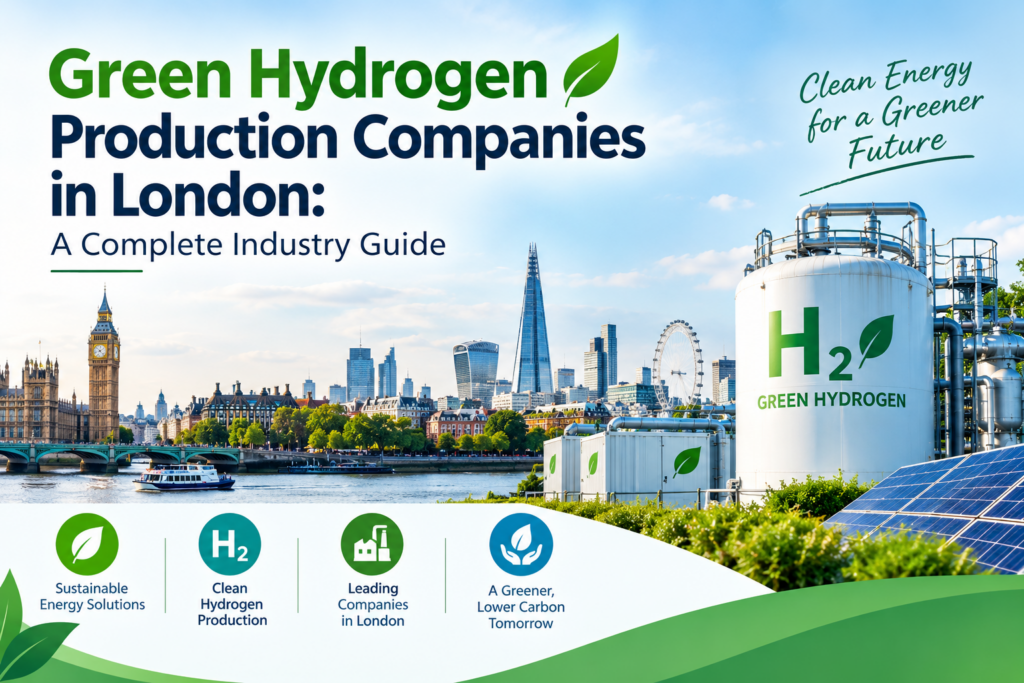
Green Hydrogen Production Companies in London: A Complete Industry Guide

London is emerging as an important market for clean energy with a growing interest in hydrogen as a solution for cutting emissions from transport, industry, logistics and energy intensive operations. Green hydrogen, which is made from renewable electricity instead of fossil fuels, is attracting particular attention among the different types of hydrogen. For businesses looking to identify the best green hydrogen production companies in London, it is important to look beyond the companies that simply produce hydrogen. The sector includes project developers, providers of electrolyser technology, energy companies, storage specialists and organisations developing complete hydrogen supply chains. This guide looks at some of the major companies and projects involved in green hydrogen production in London and the wider UK market. What’s green hydrogen? Green hydrogen is created by splitting water into hydrogen and oxygen with an electrolyze. If the electricity used in the process comes from renewable sources like wind or solar, the resulting hydrogen can have very low associated carbon emissions.Green hydrogen will be particularly useful in sectors which are hard to electrify directly. Possible applications include:  •Buses and heavy transport• Heating in industry• Production• Chemicals manufacturing• Power backup• Storage of energy• Fuels for shipping and aviation• Proportion of renewable energy The UK government is supporting the development of electrolytic hydrogen projects thru schemes like the Hydrogen Allocation Rounds. Its HAR2 shortlist lists projects across the country, including Harper Lane Hydrogen in Greater London, led by Hygiene Energy Holdings. Leading Green Hydrogen Companies and Projects in London 1. Hygen Energy Hygen is one of the companies worth watching when researching green hydrogen production companies in London. The company develops hydrogen production projects and works across applications including transport, industry, power, grid injection, and ammonia. Hygen is particularly relevant to London because its hydrogen strategy includes supplying hydrogen to transport applications. The company says it is working with partners to deliver hydrogen solutions for bus operators in cities including London. Hygen is also involved in the Harper Lane Hydrogen project, which appears on the UK government’s HAR2 shortlist for Greater London. This makes the company an important name in the region’s developing green hydrogen ecosystem. Top Green Hydrogen Companies and Projects London: 1. Hygen Energy Hygen is one of the green hydrogen production companies in London to watch out for when doing your research. The company is working on hydrogen production projects and operates in sectors such as transport, industry, energy, grid injection and ammonia. Hygen is particularly relevant to London because its hydrogen strategy is to include supplying hydrogen to transport uses. The company said it is working with partners to offer hydrogen solutions for bus operators in cities including London. Hygen is also involved in the Harper Lane Hydrogen project, which is on the UK Government’s HAR2 shortlist for Greater London. This makes the company a key name in the emerging green hydrogen ecosystem in the region. 2. ITM Power ITM Power is a leading electrolyser technology company in the UK, based in Sheffield. ITM is not just a hydrogen producer, it is very much about the technology for making green hydrogen by electrolysis. The company is developing PEM electrolyser systems that can be integrated into large-scale hydrogen production plants. ITM has also collaborated with UK hydrogen developers, such as Hygen and Protium. In 2026, ITM Power and Protium announced a strategic partnership to develop, invest and operate industrial-scale green hydrogen production plants across the UK.The significance of ITM’s role is that the growth of London’s hydrogen economy will need dependable and scalable electrolyser technology, as well as renewable electricity and hydrogen infrastructure. 3. Protium Green Solution Protium is a UK-based green hydrogen energy company developing renewable hydrogen projects. Its business model combines renewable power generation with hydrogen production and the associated infrastructure. Across the UK, the company has developed projects and teamed up with technology providers such as ITM Power. Protium and ITM partnership 2026 to support the development and operation of industrial scale hydrogen facilities. Although Protium’s current project portfolio is not confined to London, its integrated approach makes it a company to watch as the UK’s hydrogen production network expands. 4. Carlton Power Carlton Power is a UK-based energy infrastructure developer with a portfolio of green hydrogen projects across the UK. Its portfolio shows how large-scale renewable hydrogen plants can be linked to industrial customers.” For example, its Trafford Green Hydrogen project in Greater Manchester aims to produce hydrogen for industry, transport and heating using renewable energy. The project has a final installed capacity of 200 MW with an initial phase of 20 MW. Carlton Power has also set up a joint venture with Schroders Greencoat, the Green Hydrogen Energy Company, with the aim of a significant green hydrogen project portfolio in the UK.Carlton Power’s largest projects are outside London but it is relevant to the wider UK hydrogen market as companies developing the national supply chain can eventually support demand in London and other large urban centers. 5. HYRO Energi  HYRO Energy is another company involved in the growing green hydrogen scene around London. It will be sited at Kimberly-Clark’s manufacturing facility in Gravesend, Kent, for its Northfleet Green Hydrogen project. The project concerns the production of green hydrogen via electrolysis and its direct supply to an industrial customer. Detailed design, procurement and enabling works are underway with construction to commence in April 2026, the project website states. Its Kent location makes it especially relevant to the wider London and South East hydrogen economy with industrial users able to benefit from locally produced hydrogen Why green hydrogen is needed in London London has ambitious decarbonisation requirements, but not all applications can be easily converted to battery-electric or conventional renewable electricity. Hydrogen could complement electrification in sectors including heavy duty transport, industrial processes and long duration energy storage. One of the biggest advantages of producing hydrogen closer to where it is used is that it could reduce the need for transport. Local production can also help create hydrogen hubs that integrate production, storage, distribution

Green Hydrogen Production Companies in London: A Complete Industry Guide Read More »

Contract for Difference (CfD) in london

Contract for Difference (CFD) in London: How It Works, Benefits, and Risks for Investors

Trading and Investing have changed a lot in recent years. Many investors now look for flexible ways to access global markets. Contract for Difference (CFD) in London is one of the most popular options. London is a major global financial hub. It offers advanced trading platforms and strong regulations. A contract for difference allows investors to trade on price movements. This attracts traders who want flexibility and market access. However, CFDs also carry risks that investors must understand clearly. In this blog, we will learn how CFDs work in London, their benefits and risks. Also, do they suit your investment goals or not? Contract for Difference in London? A contract for difference in London is a financial agreement between an investor and a broker. The contract pays the difference between the opening and closing price of an asset. If the price moves in your favour, you get a profit. If it moves against you, you get a loss. CFDs in London cover assets like shares, indices, forex, commodities, and cryptocurrencies. Investors do not own the asset itself. They only trade on price movements. London based CFD brokers operate under strict regulatory frameworks. This provides transparency. CFDs are widely used by short term traders and experienced investors. How a Contract for Difference in London Works? To trade a contract for difference in London, an investor opens an account with a broker. The investor selects an asset and decides whether to buy or sell. Buying means expecting prices to rise. Selling means expecting prices to fall. Profits and losses are calculated on the position size. The difference between the entry and exit prices shows the outcome.  Types of Assets Traded Through CFDs in London The contract for difference in London market offers variety. One major category is shares. Traders can speculate on UK and global stocks without owning them. Indices are another popular option. Investors trade market movements like the FTSE 100 or global indices. Commodities like gold and silver are also available. Some brokers offer cryptocurrency CFDs. This variety makes London an attractive CFD trading centre. Key Benefits of Trading Contract for Differences in London One major benefit of a contract for difference (CFD) in London is market access. Investors can trade global assets. This saves time. London brokers also provide advanced tools. Another advantage is leverage. Traders can open larger positions with smaller capital. This increases potential returns. CFDs also allow short selling. Investors can profit from falling markets.  Advantages That Attract Investors to CFDs in London Flexible Market Entry and Exit CFDs help investors to enter and exit trades easily. There are no ownership transfer delays. Trades can be opened or closed in seconds. This flexibility suits those traders who respond to the market’s news and price changes. London platforms provide fast execution, which helps traders to manage volatility and make timely decisions. Access to Global Markets With a Contract for difference (Cfd) in London, investors can access markets worldwide. They can trade US stocks and Asian markets. This global reach is helpful in diversification across regions and asset classes. Investors are not limited to local markets. Risk Management Investors holding physical assets can open opposite CFD positions. This is helpful for protecting portfolios during market downturns. London CFD brokers provide tools like stop loss orders. Professional Trading Tools CFD brokers based in London provide advanced charts. This creates investor confidence. Professional tools are helpful for traders. This helps them to make better decisions. This is also helpful for managing positions efficiently. Risks of Contract for Difference in London A contract for difference in London involves significant risks. A small price movement against your position can result in large losses. Many beginners underestimate this risk. Investors may need to deposit more funds quickly. CFD trading also involves overnight financing costs. These charges reduce profits over time. Understanding these risks is important before trading CFDs in London. Regulatory Environment for CFDs in London London has a strong regulatory framework for CFD trading. Brokers must provide clear risk warnings. This protects retail investors. The contract for difference in the London market works under these rules. Regulation improves trust but does not cut trading risk. Final Call A contract for difference (CFD) in London provides global trading opportunities. Investors can trade multiple assets. London’s advanced platforms make CFD trading easy. Risks are high. It is important to understand the working of CFDs. And also, how to choose brokers. CFDs can be a powerful trading tool. These are perfect when used correctly. FAQs

Contract for Difference (CFD) in London: How It Works, Benefits, and Risks for Investors Read More »

North Sea Transition Authority

North Sea Transition Authority: Role, Responsibilities, and Impact on UK Energy Sector

The United Kingdom is in a crossroads in energy history. With the country attempting to strike a delicate balance between the urgent necessity to achieve energy security and the long-term objective of achieving net zero emissions by 2050, there is one organization that will be at the center of this balance: the North Sea Transition Authority (NSTA). The organization, which used to be called the Oil and Gas Authority, has been profoundly rebranded in 2022 to indicate a much more expanded mandate that goes way beyond the conventional hydrocarbon extraction. The NSTA is currently the mastermind behind the offshore energy development in the UK, as it facilitates the removal of the fossil-fuel-based legacy of the past and the introduction of the diversified, low-carbon future. The Evolving Role of the NSTA The main activity of the NSTA is to control and direct the oil, gas and carbon storage in the UK Continental Shelf (UKCS). Although its predecessor was more involved in the recovery of petroleum economically in an attempt to maximize its recovery, the recent NSTA is under a reformed approach that incorporates the issue of net zero commitments in each of its decisions. This twin emphasis is the reason why, as the UK relies on its own resources in order to reduce its dependence on the volatile global imports, the resources produced will do so with the least carbon footprint possible. The authority serves as an intermediary between the high-level governmental policy in climate and the technicalities of offshore activity. With the control of licensing of offshore assets, the NSTA can guarantee that the UK is a desirable location to invest in energy and at the same time face the operators responsible for their environmental performance. Basic Fundamentals and Supervision of Regulatory Bodies The North Sea Transition Authority has very extensive and technical responsibilities that span the whole lifecycle of the offshore energy projects. Licensing and Consenting: The NSTA is the controller of the North Sea. It also regulates the rounds of oil and gas exploration licenses, however, of more significance is the fact that it has introduced the first carbon storage licensing rounds in the UK. This will entail finding the right geological structures- mostly the expired gas fields- to permanently trap the captured carbon dioxide. Emission Monitoring and Reduction: It is an important attempt to control the emission of greenhouse gasses at offshore production. To curb the flaring and venting, the NSTA has enacted stringent Stewardship Expectations under which operators are expected to minimize flaring and venting. The authority motivates the industry to become more efficient in its operations by being able to track performance by annual emissions reports. Energy Integration: The NSTA advocates the idea of an integrated North Sea. This implies creating synergies across various energy industries, including electrification of oil and gas platforms by offshore wind or transforming current oil and gas pipelines into hydrogen pipelines. This is the holistic perspective which does not allow the offshore basin to be viewed as a collection of individual projects, but rather as a concerted energy system. Industry Effect on the UK Energy Industry The NSTA influence on the UK energy sector is more than immense especially in the economic stability and technological advancement. The NSTA offers the certainty that the long-term investors need by ensuring that there is a clear regulatory framework. The NSTA offers a consistent technical background in a time when the financial policy towards the operators of North Sea Transition Authority operators is frequently a matter of political controversy. Its activity guarantees the UK a just transition, which allows saving the high-skill jobs and global supply chains the oil and gas industry created and redirecting them to carbon capture and offshore wind. Besides, the NSTA emphasis on carbon capture, usage and storage (CCUS) is making the UK a global force on carbon abatement. Storing millions of tonnes of $CO 2 under the sea bed is not merely an environmental requirement but rather a booming industrial sector that the NSTA is currently fostering. Navigating a Net Zero Future The activity of the NSTA will only become more acute as the UK approaches 2030 and even later. The authority has a new role that consists of managing natural depletion of oil and gas in the North Sea and hastens the scale-up of hydrogen and carbon storage. Its value is calculated not only in barrels of oil equivalent, but also weighing the gigatonnes of carbon saved and the power of the national grid. North Sea is not a mere source of fuel anymore, it is an invaluable resource in combating climate change, and the NSTA is its main custodian. About H2Terminals We are transforming the supply chain of green hydrogen at H2Terminals through decentralizing the production and distribution. Our concept is to use green hydrogen made of wind and wave energy offshore of the North Sea Transition Authority on our offshore energy Islands. We aim to offer affordable and scalable solutions to enable countries to meet their net zero targets. Frequently Asked Questions 1. What does NSTA stand for? NSTA is an abbreviation of North Sea Transition Authority. It was previously the Oil and Gas Authority (OGA) and later re-branded in March 2022. 2. Is it a government department? The NSTA is a private, share limited company owned in its entirety by the Secretary of State of Energy Security and Net Zero. It is an executive non-departmental statutory organization. 3. Is NSTA continuing to license oil and gas? Indeed, NSTA still regulates the current licences, and manages production to maintain UK energy security, but any new activity should now be consistent with the UK net zero 2050 objectives. 4. What is the North Sea Transition Deal? It is the historic deal between the government of the United Kingdom and the offshore industry, which is supervised by the NSTA to speed up the energy transition and invest to the tune of 16 billion in low-carbon technologies. 5. What does the NSTA do in the way of Carbon

North Sea Transition Authority: Role, Responsibilities, and Impact on UK Energy Sector Read More »

Contract for Difference in London for Green Hydrogen Projects

London is moving quickly towards a low carbon future. Green hydrogen is playing an important role in the transition. It provides clean fuel for transport and power systems. But to scale, green hydrogen developers require stable revenue. This is where the Contract for Difference in London becomes important.  The Contract for Difference (CfD) supports renewable energy projects. They protect them from fluctuating market prices. It helps developers receive a predictable return when the energy prices fall. This policy provides investors with confidence for project development. The CfD frameworks make a trustworthy pathway for advanced hydrogen infrastructure. Understanding the Contract for Difference Framework The CfD is a government backed system made to encourage people towards clean and green energy. It guarantees a fixed strike price, and the government pays the difference. If the prices increase, the developer returns the extra earnings.  If the price of the market falls below the strike price, the government pays for the difference. At the same time, if the market prices rise above the strike price, the developer pays back the extra amount. This is a very simple system, as it creates a stable income for the developers. It decreases the uncertainty and boosts the investor’s trust. It makes the large hydrogen projects financially good. Why is CfD Important Today? It is helpful in reducing financial risk and encouraging private investment. It also helps to scale new technologies. To ensure stable long term revenue, it is important. It also supports national net zero targets. For green hydrogen projects, the Contract for Difference in London has become a strong foundation for growth.  Major reasons for CfD are Important. For green hydrogen, the Contract for Difference in London provides the foundation required for rapid growth and adoption. How CfD Supports Green Hydrogen Projects? CfD strengthens every stage of hydrogen project development. It makes the production process more stable. Benefits of CfD for London’s Hydrogen Ecosystem London is working to build a clean hydrogen ecosystem. Storage hubs and industrial applications all depend on a stable supply and predictable pricing. Some of the major benefits are With the suitable Contract for Difference in London support, hydrogen has become an everyday energy source for the city. Why London Needs CfD for Hydrogen Now? The energy of London is rising rapidly. The companies are looking for low carbon solutions. Green hydrogen can easily fill this gap, but it happens only when the ecosystem grows fast. Why is this Moment Necessary? A Contract for Difference in London makes sure that green hydrogen becomes cost competitive and widely available. How H2Terminals Helps Build CfD Projects? H2Terminals supports hydrogen developers at every stage of creating a project. From planning to storage, we help many companies to use CfD advantages effectively. Our Features We work with developers and investors to create a strong and future ready hydrogen network. Building a Clean Hydrogen Future for London London’s journey toward clean energy requires strong policy to support. The Contract for Difference in London mechanism creates a safe environment for all the hydrogen producers. With improved price stability and faster growth, hydrogen can replace fossil fuels across the transport and other systems. H2Terminals is committed to supporting this transformation. We provide highly advanced technologies that go with London’s growing energy needs. Together, we build a cleaner and smarter hydrogen future.

Contract for Difference in London for Green Hydrogen Projects Read More »

Advanced Hydrogen Storage in London Solutions for a Clean Energy Future

London is a beautiful city that is moving quickly towards a clean and sustainable future. The green energy demand is rising, and hydrogen has become a leading solution for this. It is clean and efficient to use. To support this transition, trustworthy, scalable storage solutions are important. At H2 Terminals, we provide high hydrogen storage in London designed for safety and long term performance. Hydrogen plays a very major role not only in industries but also in homes. But the true potential comes when the storage is safe and future ready. Our systems help London reduce emissions. We support businesses that are looking to adopt clean energy solutions. With our modern technology, hydrogen has not only become a fuel but also a practical everyday resource. The Future of Clean Energy in London Today, hydrogen has become one of the cleanest energy sources. It produces zero carbon emissions when used as a fuel. It manages the city’s goal of becoming a net zero leader. But effective storage is necessary for making hydrogen usable all over London.  Why is Hydrogen Important? Hydrogen is helpful in maintaining London’s energy needs. It also reduces dependence on fossil fuels.  Our Advanced Hydrogen Storage Technologies Safe and good storage is at the heart of any hydrogen ecosystem. We give modern systems that combine with safety standards. We also support large scale adoption. Our technologies support hydrogen storage in London, efficient and future ready. Advantages of Hydrogen Storage for London’s Future Hydrogen Storage in London provides more than only energy backup. It is helpful in business growth and a cleaner environment. Industries That Benefit from Hydrogen Storage Hydrogen storage is helpful in several sectors across London. It ensures safety and efficient operation for diverse industries. Our storage systems are made to support every sector that is working toward a green future. Why Choose H2 Terminals for Hydrogen Storage in London? H2 Terminals provides safe and advanced hydrogen storage solutions. The modular storage solutions are tailored to London’s growing energy requirements. Our strength is that we have certified storage systems. We make sure to maintain high safety standards. Our designs are scalable and modular. We have fast deployment and expert technical support. We provide long term maintenance options. We work with close businesses and city planners. We help them to build a strong hydron network for London. Driving London Toward a Cleaner Tomorrow London’s step into clean energy requires trustworthy partners. We support small businesses and communities looking to adopt hydrogen. We use advanced technologies to make hydrogen a primary energy source. Our system helps in creating a safer and greener city. Hydrogen is more than a fuel and has turned into the future of clean energy. With the right storage, London can lead the world.  If you are the one who is looking to adopt hydrogen solutions or build a clean transport fleet, we are the ones who can help you out. Discover the most advanced hydrogen storage in London and join the movement toward a cleaner tomorrow. FAQs

Advanced Hydrogen Storage in London Solutions for a Clean Energy Future Read More »