
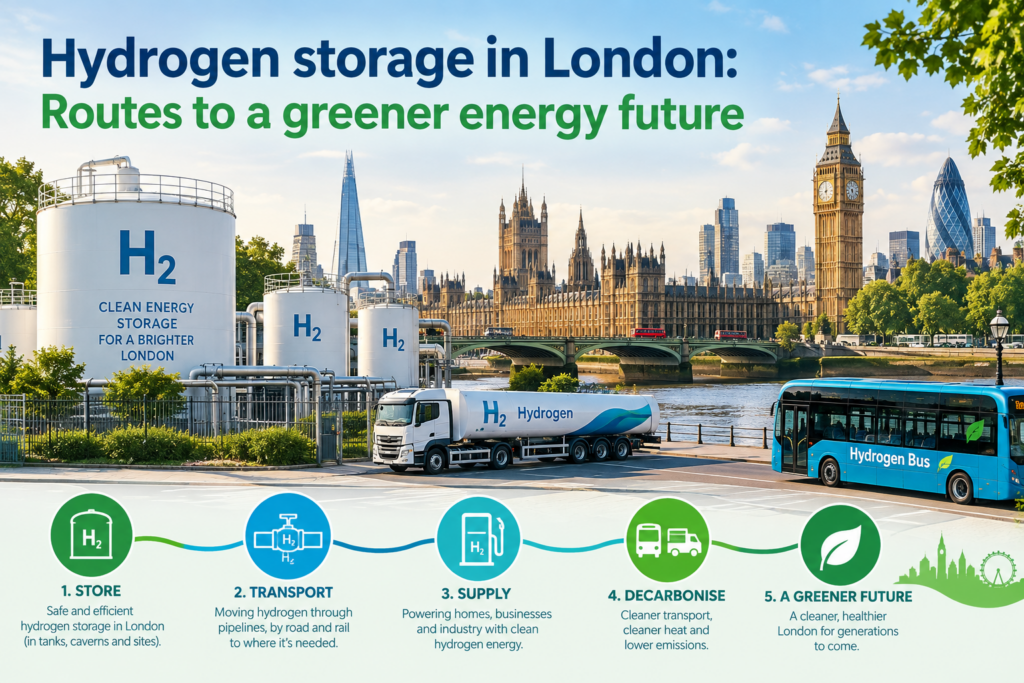
London is at the center of the UK’s move toward a cleaner, more resilient energy system. Hydrogen is emerging as a potential low-carbon energy carrier as transport networks, industries, public infrastructure, and companies work to reduce their carbon emissions. But the production of hydrogen is only half the battle. Storing it safely and efficiently is also a critical component of building a dependable hydrogen economy.
The question of hydrogen storage in London is becoming ever more pertinent as the capital looks at ways it can support clean energy, industrial decarbonization, low-carbon transport, and energy security. Good storage solutions can help to balance changes in the amount of hydrogen that is available and the amount that is needed and can make sure that hydrogen is available when it is needed and where it is needed.
Hydrogen projects can be complex, so if you are an organization considering a hydrogen project, working with experienced H2P Energy Consultants in London can provide helpful support in understanding technical, commercial, regulatory, and infrastructure requirements.
London’s Energy Transition: The Importance of Hydrogen Storage
Hydrogen can be produced using a range of technologies and has the potential to be used across sectors that are hard to decarbonize using direct electrification alone. The applications are heavy transport, industrial processes, energy storage, and some high-temperature applications.
But it’s unlikely that hydrogen demand will be constant over a day or a year. Output can also be affected by the availability of electricity, renewable generation, or operating conditions.
This requires efficient storage of hydrogen.
Storage can assist:
• Balance supply and demand of hydrogen
• Enhance energy system flexibility
• Provide backup power during outages
• Support hydrogen’s industrial users
• Refueling infrastructure enablement
• Enhance asset utilization for hydrogen production
* Support integration of renewable energy
Developing an appropriate storage strategy can therefore be an important part of a wider Decarbonization Strategy in London for London-based organizations.
Hydrogen Storage Technologies Demystified
Hydrogen can be stored in many ways. The right technology is determined by factors such as capacity required, pressure, application, location, duration, safety requirements, and cost.
Compressed Hydrogen Storage (CHS)
Compressed gas storage is one of the more mature solutions for hydrogen applications. Hydrogen is compressed and stored in tanks or containers at high pressure.
Such an approach is especially relevant for applications where relatively fast hydrogen dispensing is required, e.g., some transport applications.
The main benefits include:
• Proven technology
• Simple to deploy
• Rapid access to stored hydrogen
• Suitable for small and medium-sized applications
However, compression requires energy, and storage vessels must be built to appropriate engineering and safety standards.
Liquid Hydrogen Storage
Hydrogen can also be turned into a liquid by cooling it to very low temperatures. Liquid hydrogen is more energy dense in volume than compressed hydrogen and so may be attractive where there is a need to store or transport large quantities.
Liquefaction, however, is energy-intensive and requires specialized cryogenic infrastructure.
Thus, feasibility studies are necessary for large-scale projects before the choice of liquid hydrogen storage.
Hydrogen Storage Underground
Underground storage is another area of considerable focus for long-duration and potentially large-scale energy storage.
Suitable salt caverns or other formations may be considered for potential geological storage, subject to geological, regulatory, engineering, and environmental considerations.
Eventually, large-scale storage could also provide hydrogen networks with hydrogen when demand is low and take hydrogen away from the network when demand increases.
Hydrogen storage and London’s decarbonization objectives
Hydrogen storage cannot be viewed in isolation from the broader energy transition.
A successful decarbonization strategy for London needs to consider interactions across different energy technologies. Electrification, energy efficiency, renewable power, hydrogen, energystorage,e and alternative fuels can all do different things.
Hydrogen could be particularly useful for applications where direct electrification is technically difficult, expensive, or operationally unsuitable.
Storage provides the flexibility that reinforces this proposition.
For example, hydrogen can be stored when there is plenty of renewable electricity and used later. This provides a way to move the available energy through time.
Businesses considering long-term carbon reduction programs should be looking at hydrogen storage, alongside electrification and other low-carbon technologies.
H2P Energy Consultants London
But hydrogen infrastructure planning is so much more than swapping in a storage tank or technology.
Organizations need to balance demand forecasts, production options, transportation requirements, safety, regulatory, capital expenditure, operating costs, and future scalability.
This is where H2P Energy Consultants in London can add value.
Specialist energy consultants can help organizations assess the technical and commercial viability of hydrogen projects as part of their wider decarbonisation aims.
A hydrogen consultancy project could involve:
1. Preliminary feasibility study – Determining the organization’s hydrogen needs & objectives.
2. Demand analysis—Estimates of current and future hydrogen use.
3. Technology assessment—Comparison of appropriate technologies for production and storage.
4. Infrastructure planning – Assessment of storage, distribution, compression, and connectivity needs.
5. Risk assessment—Identification of technical, operational, and safety considerations.
6. Economic modeling—Comparison of capital and operating costs.
7. Strategic planning—Connecting the project to long-term energy and carbon reduction aspirations.
This systematic approach helps to reduce uncertainty and helps businesses to make informed investment decisions.
Hydrogen Storage in Industry
London and the wider UK industrial sector are under ever-growing pressure to cut emissions while remaining productive and competitive.
Hydrogen could be a possible alternative energy source for selected industrial processes where conventional electrification is difficult.
Storage also offers additional operational flexibility for industrial users.
In a facility, hydrogen may be required at a fairly constant flow rate, but the hydrogen production or delivery may be intermittent. Storage can be a buffer between supply and demand.
This will help companies to manage supply variations and improve the reliability of hydrogen-powered equipment.
Hydrogen Storage & Transport
Hydrogen storage can be important in another field: transportation.
Hydrogen fuel-cell vehicles need reliable access to hydrogen refueling infrastructure. Refueling stations need to have enough storage capacity to deal with demand and to supply hydrogen at the right pressure levels.
Heavy-duty vehicles, buses, specialist fleets and potentially other transport applications could require different infrastructure configurations.
As hydrogen mobility grows, strategically placed storage facilities could be a key part of London’s clean transport ecosystem.
Safety Issues in the Storage of Hydrogen
Safety considerations regarding hydrogen storage in London. Safety is one of the most important considerations in the planning of hydrogen storage in London.
Hydrogen has different physical and chemical properties than traditional fuels. Low molecular weight , highly flammable , can disperse quickly .
Hydrogen storage projects therefore require appropriate engineering controls, monitoring systems, ventilation, leak detection, separation distances, emergency procedures, and trained personnel.
Projects must also meet the relevant UK regulations, planning requirements, engineering standards, and health and safety obligations.
“These requirements should be determined in the early stages of project development during a professional feasibility assessment, rather than being an afterthought of safety.
Hydrogen Storage Combined with Renewable Energy
A very exciting opportunity for hydrogen is its potential connection to renewable electricity.
Solar and wind power is dependent on the weather and time of day. Hydrogen could serve as an energy carrier, converting available electricity into hydrogen for storage and later use.
This provides a way for the potential energy:
Renewable electricity → Hydrogen production → Hydrogen storage → Hydrogen utilization
This model can offer more flexibility to energy systems when well integrated.
As businesses develop a decarbonization strategy in London, it can be valuable to assess the role of hydrogen alongside renewable generation and energy storage to identify opportunities to reduce emissions and improve the long-term resilience of energy supply.
Picking the Right Hydrogen Storage Solution
There is not one-size-fits-all storage solution for all hydrogen projects.
The right one will depend on a few factors, including:
• Hydrogen demand
• Length of storage
• Necessary capacity
• Frequency of delivery
• Working pressure
• Site area available
• Safety requirements
•Capital investment
• Overhead costs
• Expansion plans underway
The storage configuration of a small hydrogen refueling facility may be very different to that of a large industrial or energy project.
This is why organizations should conduct a detailed feasibility study prior to committing to an infrastructure investment.
London, The Future of Hydrogen Storage
The development of hydrogen storage in London is likely to remain tied up with wider changes to the UK’s energy system.
With the development of hydrogen production technologies and the increase in demand, storage infrastructure may become an increasingly important link between production and end users.
Future hydrogen networks could include local storage, transport infrastructure, industrial demand, renewable energy, and potentially large-scale storage facilities.
Digital monitoring and intelligent energy management systems could assist operators to better match supply, demand, and available capacity, further improving storage utilization.
“Early planning for businesses, for example, could allow them to see where hydrogen could realistically fit into their long-term energy strategy.”
Why You Need Professional Hydrogen Planning
Hydrogen projects involve a complex web of technical, commercial, environmental, and regulatory decisions. A bad storage solution can increase costs, limit scalability, or create operational headaches.
Businesses are able to work with experienced H2P energy consultants in London to assess these factors before a large investment is made.
Organizations should start with the problem they are trying to solve – how much hydrogen they need, when they need it, where it will come from, and how reliably it needs to be supplied – rather than choosing a technology first.
It is a pathway that can provide a more pragmatic and economically sustainable hydrogen strategy.
Abstract
Hydrogen storage in London could play an important part in supporting the city’s transition toward a more flexible and sustainable energy future. Different technologies can be used to meet different energy needs, from compressed hydrogen systems and liquid storage to potential large-scale underground solutions.
Storage can help balance supply and demand, support hydrogen transport, strengthen industry applications, and complement renewable energy generation.
For businesses looking to use hydrogen, storage for hydrogen is not a standalone infrastructure decision but should be part of a wider decarbonization strategy for London. Specialist H2P energy consultants in London can help organizations look at technology options, project viability, safety requirements, costs and longer-term opportunities.
The hydrogen economy is evolving, and the organizations that give due consideration to their storage needs today will be better placed to be part of the UK’s low-carbon energy landscape.
Frequently Asked Questions?
1. Why is hydrogen storage important in London?
Hydrogen storage in London can help to balance hydrogen supply and demand, improve energy flexibility, support transport and industrial applications, and provide backup capacity where continuous hydrogen availability is required.
2. What are the major types of hydrogen storage?
The main approaches are compressed gaseous hydrogen, liquid hydrogen, and possible large-scale underground storage. The best choice depends on the capacity, duration, application, location, cost, and safety requirements.
3. How can hydrogen support London’s decarbonization strategy?
Hydrogen can complement electrification and renewables in sectors where direct electrification may be difficult. A decarbonization strategy in London can include hydrogen and storage to help organizations assess further options for carbon reduction.
4. What is H2P Energy Consultants London?
H2P Energy Consultants in London can support organizations with hydrogen feasibility studies, technology assessment, demand analysis, infrastructure planning, economic studies, risk considerations, and wider energy strategy development.
5. Is it safe to store hydrogen?
Hydrogen can be safely stored if suitable engineering systems, monitoring, ventilation, leak detection, operational procedures, and safety standards are adopted. Professional risk assessment should be done during project planning.
6. How do companies select the most suitable hydrogen storage technology?
Businesses should consider hydrogen demand, storage capacity, storage period, operating pressure, site constraints, costs, safety requirements, supply arrangements, and future expansion. A comprehensive feasibility study can assist in determining the most suitable solution.